

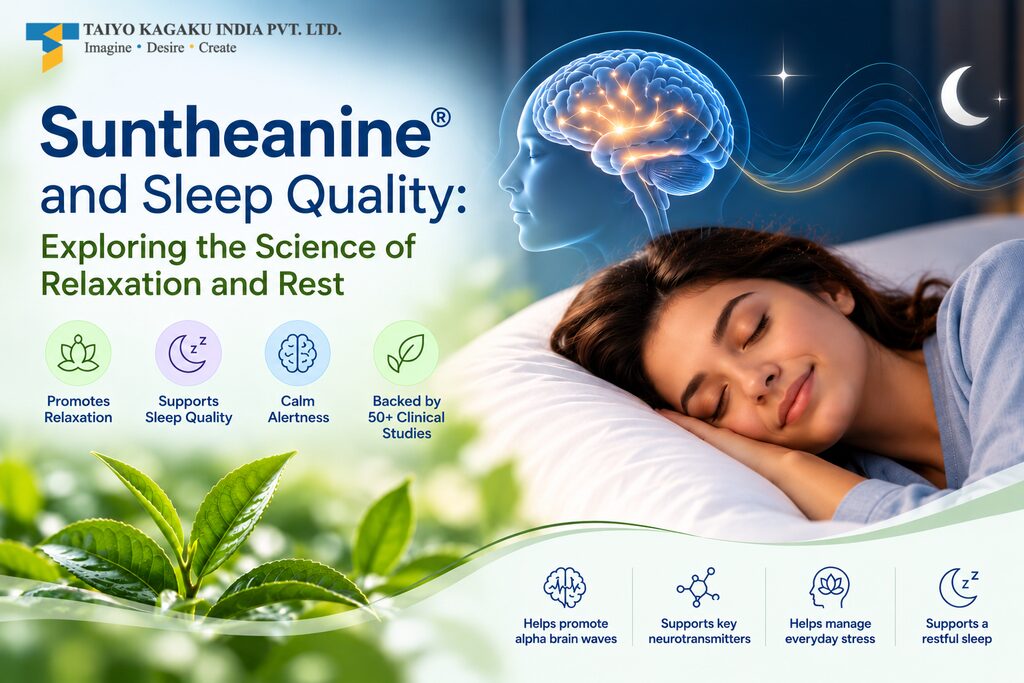
Understanding the Connection Between Relaxation and Sleep
A good night’s sleep begins long before we close our eyes. Our ability to unwind, manage everyday stress, and transition from wakefulness to rest can influence the quality of our sleep. Yet, for many people, switching off at the end of a demanding day is not always easy.
This has encouraged growing scientific interest in nutritional ingredients that may support relaxation and healthy sleep patterns. One such ingredient is L-theanine, a non-protein amino acid naturally found in tea leaves.
Known for its association with relaxation without pronounced drowsiness, L-theanine has attracted research interest for its potential effects on stress responses, mental relaxation, and sleep-related outcomes.
Suntheanine®, Taiyo’s Fermented L-theanine, brings this research area into focus. But what does the scientific evidence actually tell us about L-theanine and sleep quality? And how might relaxation contribute to a healthier transition into rest?
1. What Is L-Theanine?
L-theanine is a naturally occurring amino acid found predominantly in tea plants. Unlike amino acids used to build proteins, L-theanine is classified as a non-protein amino acid.
Researchers have investigated its effects on aspects of brain activity, mood, attention, and relaxation. Its structural similarity to certain neurotransmitters has prompted scientific interest in how it may influence the central nervous system.
Unlike conventional sedative approaches, L-theanine is studied primarily for its potential to promote a state of relaxation without necessarily inducing sleepiness.
This distinction matters because relaxation and sleep are related but different processes. Feeling calmer does not automatically mean falling asleep faster or sleeping for longer. Understanding this difference is essential when evaluating the evidence for L-theanine as a sleep-support ingredient.
2. Why Is Relaxation Important for Sleep Quality?
Sleep is influenced by multiple factors, including circadian rhythms, sleep pressure, environmental conditions, lifestyle habits, and psychological state.
Stress and persistent mental activity can make it difficult to settle down at bedtime. When the mind remains engaged with work, responsibilities, or everyday concerns, the transition from wakefulness to sleep may become more challenging.
3. What Does Clinical Research Say About L-Theanine and Sleep?
Scientific interest in L-theanine has expanded from relaxation and attention to include sleep-related outcomes.
A systematic review, published online in November 2025 and appearing in Nutritional Neuroscience in 2026, assessed 13 trials involving 550 participants that investigated L-theanine as a standalone intervention. The authors reported encouraging findings across several sleep-related outcomes while highlighting the need for further high-quality research.
Together, these reviews suggest that L-theanine has the potential to support certain aspects of healthy sleep.
4. Suntheanine®: Bringing Research-Backed L-Theanine to Ingredient Development
Suntheanine® is produced using a patented enzymatic process designed to mimic the natural production of L-theanine in green tea leaves.
Suntheanine® is a highly pure form of L-theanine and is designed for use in dietary supplements, carbonated beverages and other suitable food and nutraceutical applications.
5. Beyond Sleep: The Broader Research Interest in Relaxation
Interest in L-theanine extends beyond nighttime routines. Researchers have also examined its potential effects on attention, mood, and responses to stressful situations. It is also backed with 50+ Clinical Studies.
Connect with Taiyo Kagaku India to learn more about Suntheanine® and its potential applications in suitable nutritional and wellness products.
How Does Suntheanine® Work Inside the Body and Brain to Support Relaxation and Sleep?
What happens inside the body when we consume Suntheanine®? How can an amino acid influence the way we respond to stress and prepare for rest?
The answer lies in how L-theanine is absorbed, reaches the brain, and interacts with processes involved in relaxation and mental alertness.
1. From the Gut to the Brain
After oral consumption, Suntheanine® is absorbed through the small intestine and enters the bloodstream. L-theanine can cross the blood–brain barrier, allowing it to reach the central nervous system.
Once in the brain, L-theanine may influence several pathways involved in neurotransmission and brain activity. These processes are being investigated to understand its potential effects on relaxation, attention, and responses to stress.
2. Supporting a Relaxed but Alert Brain State
One of the most studied effects of Suntheanine® is its association with changes in brainwave activity.
Human studies have reported increases in alpha-wave activity following L-theanine consumption. Alpha waves are commonly associated with a state of relaxed wakefulness, such as the calm alertness experienced during meditation.
L-theanine may also influence beta-wave activity, which is associated with active mental processing and alertness. These findings have contributed to scientific interest in Suntheanine® as an ingredient that may support relaxation without necessarily causing pronounced drowsiness.
3. Interacting with Neurotransmitters Involved in Stress Regulation
Neurotransmitters are chemical messengers that help nerve cells communicate with one another. The balance between excitatory and inhibitory signaling contributes to how the brain processes information and responds to its environment.
Research suggests that L-theanine may influence pathways involving glutamate, GABA (gamma-aminobutyric acid), and other neurotransmitters associated with brain signaling and mood regulation.
Suntheanine® brings scientific interest in L-theanine into focus, offering a research-backed ingredient for exploring the connection between relaxation, stress management, and sleep quality. By reaching the brain and potentially influencing brainwave activity and neurotransmitter pathways, L-theanine may support a relaxed mental state that helps prepare the body for rest. While clinical research continues to investigate its effects on sleep, the findings so far highlight its potential in suitable wellness formulations. With its patented enzymatic production process and established research background, Suntheanine® offers ingredient developers opportunities to explore innovative solutions for relaxation and sleep support.