
Sunfiber: A Safe and Effective Way to Relieve Constipation
Sunfiber® is a clear water-soluble dietary bean FSSAI approved prebiotic fiber (partially hydrolyzed Guar Gum, PHGG). An all natural galactomannan soluble fiber that is tasteless, colorless and odourless. Sunfiber® delivers high fiber content and excellent pH, heat and freeze/thaw stability. Clinically proven to lower glycemic index, improve mineral absorption and promote digestive health (Constipation, Diarrhea, and IBS). Sunfiber also has FSSAI Health claim where “Consumption of PHGG may help to releive the symptoms of Constipation”.
Powder Properties:
- Free flowing powder
- Rich fiber source
- Low hygroscopicity
- Low calorie food
- Heat tolerant
- Taste free
- Effective even in low dosages

Solution Properties:
- Highly soluble
- Invisible in solutions
- Stable at low pH
- Low viscosity
- No influence on mouth feel
- Heat tolerant, salt tolerant
- No Browning reaction with protein

The Incredible Transformation:
Before and After Effects of Sunfiber
The results of consuming Sunfiber (PHGG) by different customers
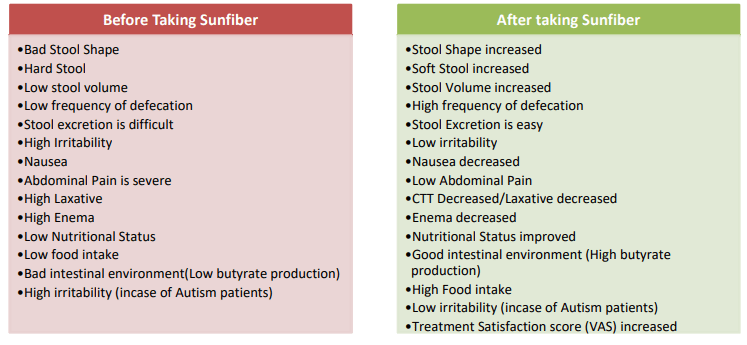
This shows that Sunfiber can not only improve constipation, decrease nausea, decrease abdominal pain but also over all nutritional status improved. This prove that Sunfiber is very optimum for the consumers who are suffering from the constipation.
With dosage of 5gms -18gms of Sunfiber per day, Constipation was relived from all the ages of group in Elderly, healthy, Chronic, Hemodialysis, Autism, Cancer, Multiple myeloma cancer, Constipated, Mentally physically challenged and colorectal cancer. Thus, Sunfiber is the most optimum for consumers who are suffering from constipation. It can also be used in various application such as dietary supplement, food, beverages, RTD and more.
Fore More information, Please contact us directly
Reference:
1. Nakagawa M. et al. Journal of Nutritional Food. 11.1-14 (2008)
2. Polymeros D, et al, Dig Dis Sci, 59, 2207-2214 (2014)
3. Tomoko Uemura, et al. ” Constipation, and improved nutritional status in hemodialysis patients treated with PHGG.” Intravenous Enteral Nutrition. 29.3 (2014): 857-862.
4. Miyoshi M, et.al, J Med Sci. 2020 Apr 1;66(1):E12-E21. PMID: 32814753; PMCID: PMC7447100.
5. Inoue R, et al. J Clin Biochem Nutr.64,217-223 (2019)
6. Toda, E. et al.), Abstracts of the 29th Annual Meeting of the Japanese Society of Venous and Enteral Nutrition: pp. 556 (2014). No. P-0643
7. Üstündağ G, et al. Can partially hydrolyzed guar gum be an alternative to lactulose in treatment of childhood constipation? Turk J Gastroenterol. 2010 Dec;21(4):360-4. doi: 10.4318/tjg.2010.0121. PMID: 21331988.
8. Patrick PG, Gohman SM, Marx SC, DeLegge MH, Greenberg NA. Effect of supplements of partially hydrolyzed guar gum on the occurrence of constipation and use of laxative agents. J Am Diet Assoc. 1998 Aug;98(8):912-4. doi: 10.1016/S0002- 8223(98)00210-7. PMID: 9710664.
9. Okazaki H, et al. Improvement in defecation by a beverage containing partially hydrolyzed guar gum. Journal of Nutritional Food. 1992;2:1-8
10. Yukiko Sakata, et al, How much does partially hydrolyzed guar gum affect the weight, moisture and hardness of feces. 53th Japanese Journal of Public Health.
11. Cristina V. et al, Long term fiber intervention program: Reduction in Enema use at a developmental care facility, J . Am. Diet Assoc. 2000s:100(9):A82
12. Hidehisa Takahashi, et al, Effect of partially hydrolyzed guar gum on fecal output in human volunteers, Nutrition Research, Vol. 13, pp.649-657,1993
13. Hidehisa Takahashi, et al, Influence of Partially Hydrolyzed Guar Gum on Constipation in Women. J. Nutr, Sci. Vitaminol., 40, 251-259, 1994
14. Toshiaki Tanaka, et al, Effects of rice gruel containing partially hydrolyzed guar gum on human defecation. Health. Nutrional food research Vol. 3 No.2 2000